
Hebel vs Brick Cost: External Finishes Compared
- Ken Yazici

- Mar 27
- 3 min read
When building a home, the external finish is often driven by appearance. But beyond that, it plays a key role in cost, thermal performance, and long-term maintenance.
The three most common systems used across residential construction are:
Hebel (AAC panel system)
Common brick with render
Face brick
Each delivers a different balance of upfront cost, performance, and durability. Understanding how they compare helps you make a more informed decision early in the design process.
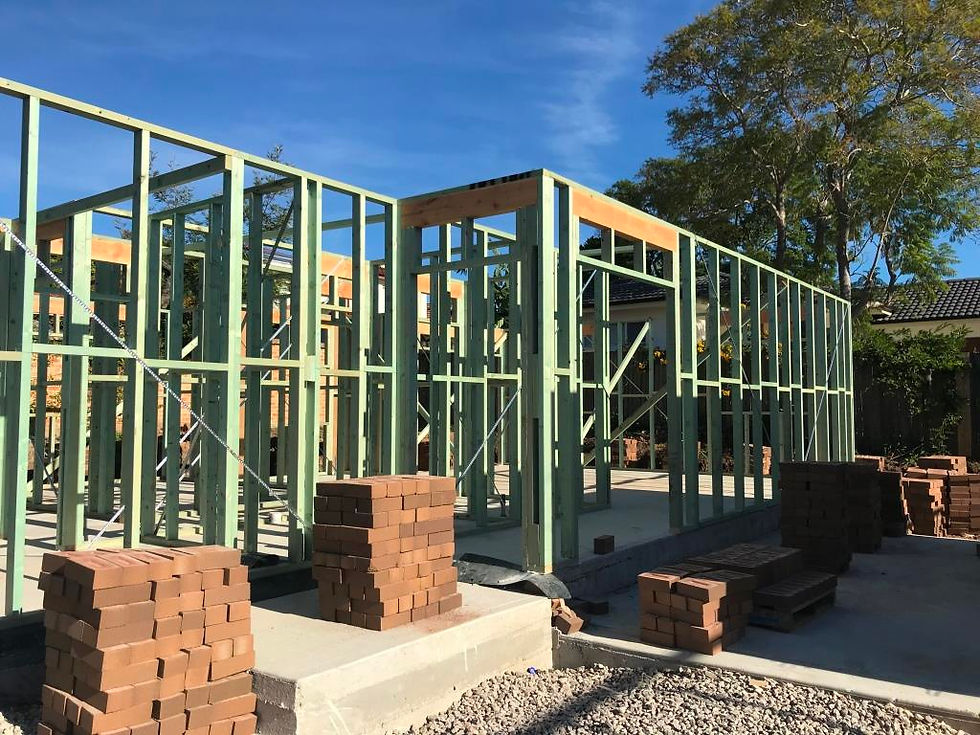
Hebel (AAC Panel System)
What is Hebel?
Hebel is a lightweight Autoclaved Aerated Concrete (AAC) panel system installed over a structural frame and finished with a render system.
It’s widely used in modern homes where a clean, rendered façade is the desired outcome.
How is it used?
Hebel is installed as a panel system rather than traditional masonry.
Panels fixed to top hats over the structural frame
Joints set and reinforced
Acrylic render system applied
Typically finished with a texture coat
In our builds, we take a slightly different approach:
Full render system
Followed by a two-coat paint system instead of a tinted texture coat
This provides:
A more consistent finish
Greater flexibility for future repainting and maintenance
Thermal performance
Hebel performs strongly from an insulation perspective.
Higher R-value than standard brick veneer
Reduces heat transfer through the building envelope
Typically contributes to improved energy efficiency
In practical terms, homes using Hebel can experience more stable internal temperatures and reduced heating and cooling loads compared to standard masonry systems .

Common Brick with Render
What is it?
This is a traditional brick veneer system in which the brickwork forms the base, while the final finish is achieved through rendering and painting.
How is it used?
Construction follows a layered process:
Brickwork completed first
Render applied across the façade
Painted to achieve the final finish
Compared to panel systems, this introduces additional trades and sequencing during construction.
Thermal performance
Common brick with render provides moderate thermal performance.
Benefits from some thermal mass
Limited inherent insulation unless supplemented
Compared to Hebel:
Feels more solid and dense when tapped
Lower insulation performance
Greater reliance on heating and cooling to regulate internal temperatures

Face Brick
What is it?
Face brick is a finished masonry system in which the brick itself serves as the final external surface.
No render
No paint
No applied coating systems
How is it used?
Standard brick veneer construction
Higher level of finish required during bricklaying
Brickwork and joints remain exposed
This removes the need for additional finishing trades and ongoing repainting.
Thermal performance
Face brick provides strong thermal mass.
Absorbs and releases heat slowly
Can contribute to internal temperature stability
However:
Lower insulation performance than Hebel unless additional insulation is incorporated

Hebel vs Brick Cost Comparison Case Study – Typical Two-Storey Build
Using a typical two-storey home with approximately 360m² of external wall area, Hebel forms the baseline for comparison.
Hebel (Baseline)
The most cost-effective of the Three Building Methods
Strong insulation performance
Requires periodic repainting over time
Common Brick with Render
Approx. $14,500 additional investment above Hebel
Similar rendered appearance
Additional construction steps and trades
Over time, this system will typically require:
Repainting
Minor crack maintenance in rendered surfaces
Face Brick
Approx. $35,500 additional investment above Hebel
No requirement for render or paint
Minimal ongoing façade maintenance
Face brick is often chosen for:
Durability
Reduced long-term upkeep
Consistent appearance over time
Final Thoughts
When comparing external finishes, one of the most common considerations is hebel vs brick cost. While Hebel generally offers a more cost-effective starting point with stronger insulation performance, brick-based systems involve a higher upfront investment but offer greater solidity and long-term durability depending on the finish.
Each system delivers a different balance, and none is inherently better than the others.
Hebel offers a strong combination of cost efficiency and insulation performance
Common brick with render achieves a similar visual outcome through more traditional construction methods
Face brick provides long-term durability with minimal maintenance requirements
Bottom Line
The right choice comes down to prioritising.
If you’re focused on upfront cost and thermal performance, Hebel performs strongly
If you prefer a rendered aesthetic using traditional masonry, common brick with render is a viable option
If long-term durability and low maintenance are key, face brick remains a solid choice
Each system has its place. The key is selecting the one that aligns with how you want your home to perform over time.


Comments